
An airport's market isn't just the people who live nearby
Who is an airport serving? Inbound or outbound?
Auckland has ~1/3 of New Zealand's residents but 22.5% of international guest nights. Queenstown has 0.6% of residents and 17.3% of international guest nights. Rotorua, the West Coast and Fiordland lean the same way.
While this isn't the best measure to show inbound/outbound airport split (Queenstown for example is 90% inbound) it does show the stark difference in how tourism is unevenly distributed around the country. Maybe places like Queenstown need a little more love to support the number of visitors?
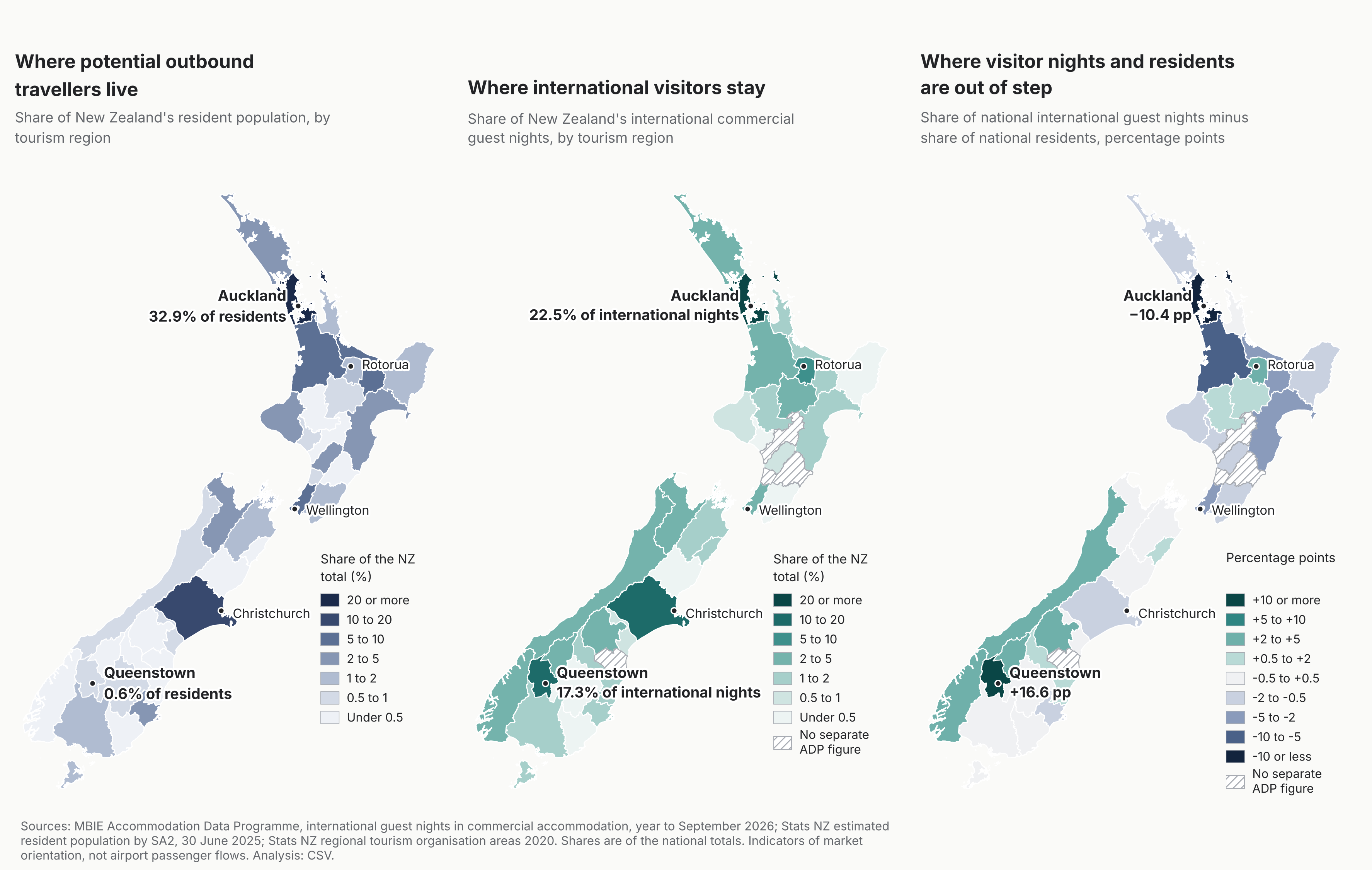
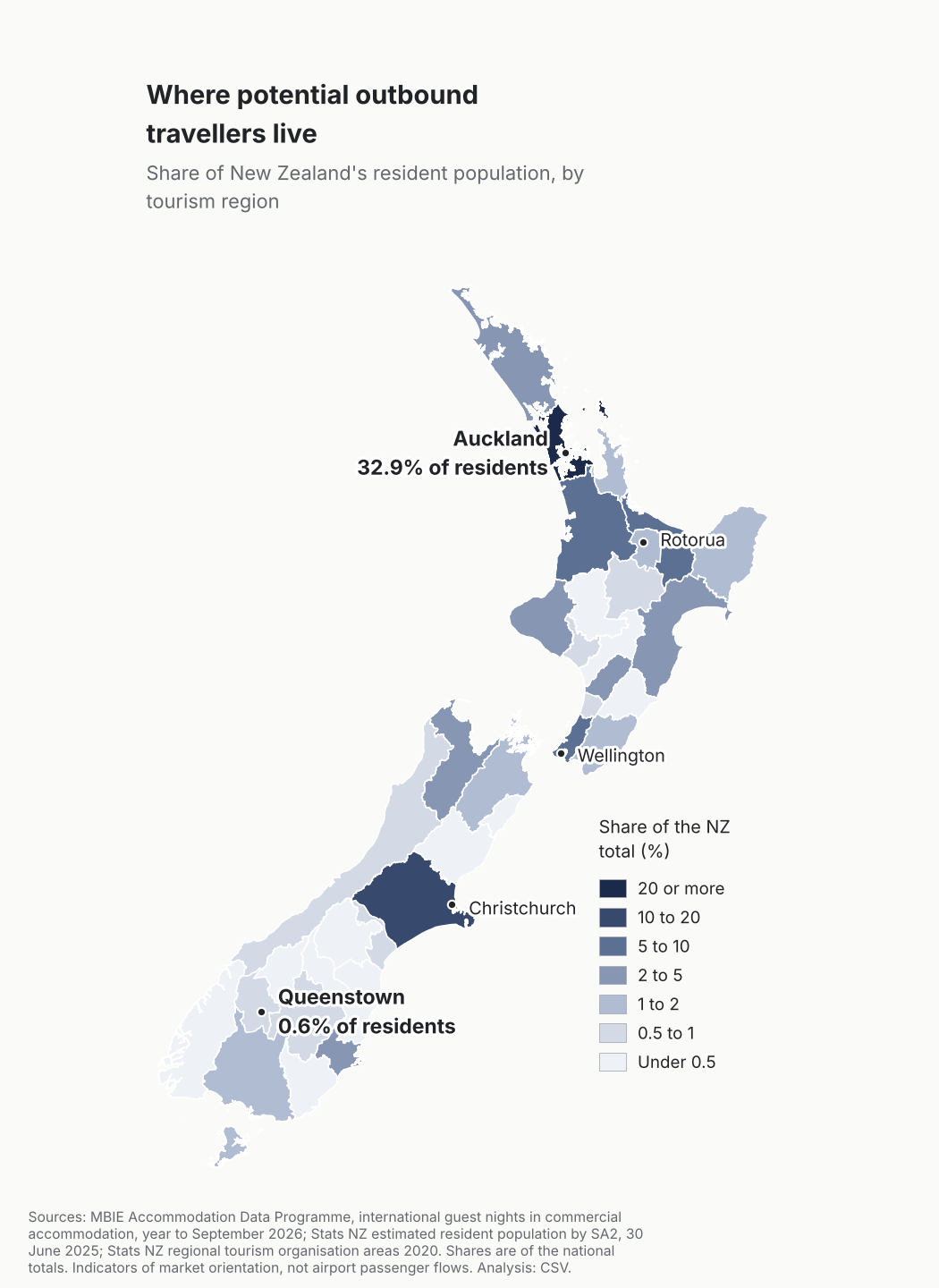
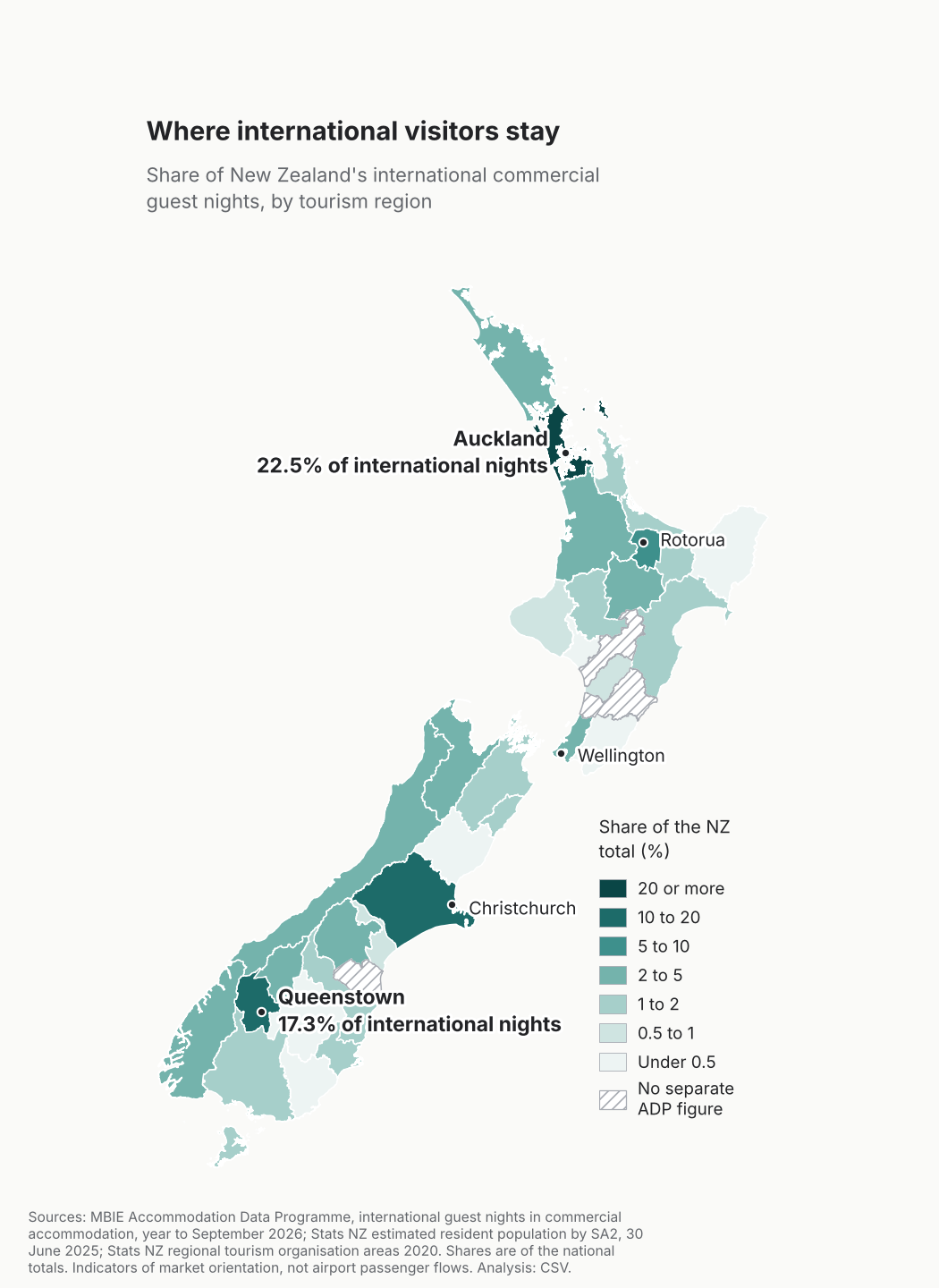
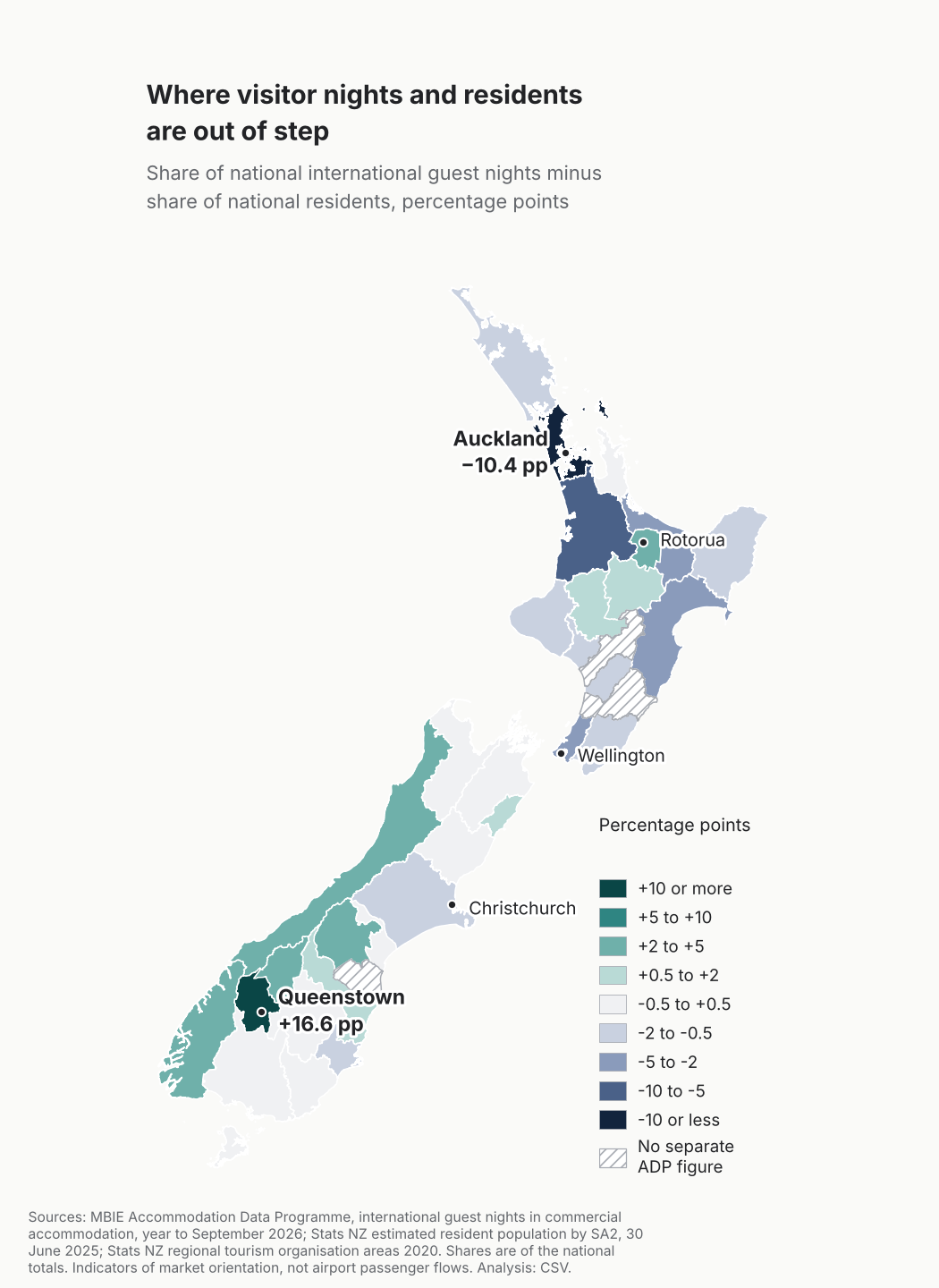
Auckland: 32.9% of residents; 22.5% of international commercial guest nights.
Queenstown: 0.6% of residents; 17.3% of international commercial guest nights.
Auckland is the biggest single region on both measures, but it is not close to balance: it has 32.9% of residents and 22.5% of international commercial guest nights, a gap of −10.4 pp. Its resident base is still the larger share of the two. Queenstown has 0.6% of residents and 17.3% of international nights, a gap of +16.6 pp. That is the clearest example of a destination whose overseas visitor market is large relative to the people who live there.
| Region | Residents (% of NZ) | International nights (% of NZ) | Gap (percentage points) |
|---|---|---|---|
| Queenstown | 0.6 | 17.3 | +16.6 pp |
| Fiordland | 0.1 | 3.1 | +3.0 pp |
| Mackenzie | 0.1 | 3.0 | +2.9 pp |
| Rotorua | 1.5 | 5.3 | +3.9 pp |
| Canterbury | 11.3 | 10.7 | −0.6 pp |
| Wellington | 9.6 | 4.7 | −4.9 pp |
| Auckland | 32.9 | 22.5 | −10.4 pp |
| Waikato | 8.0 | 2.1 | −5.9 pp |
These maps compare resident population with international commercial accommodation nights. They indicate market orientation, rather than airport passenger flows. Length of stay, accommodation coverage, airport catchments and visitors travelling through other gateways affect the relationship. The gap compares each region's weight in the national totals, not the mix of visitors within the region: a small region such as Queenstown has so few residents that its own visitor mix is far more one-sided than the gap suggests. A negative gap means a region has a larger share of residents than of international nights. It says nothing about how attractive a destination is or how well its airport performs.
Source: MBIE Accommodation Data Programme (ADP), international guest nights in commercial accommodation (hotels, motels, holiday parks, backpackers and lodges; not holiday homes or Airbnb; not all visitor stays or unique visitors), all property types, October 2025 to September 2026. Stats NZ estimated resident population by SA2 at 30 June 2025, added up by Stats NZ regional tourism organisation areas 2020.
Units: percentage of the New Zealand total. Population shares use the SA2 total (5,131,370 people) and nights shares use the published ADP New Zealand total (15,087,700 nights). Gap = international nights share minus population share, in percentage points.
Coverage: 144,400 international nights (1.0% of the total) are not attributed to any reported region. Horowhenua, Kawerau, Rangitikei, Tararua, Waimate have no separate ADP figure, so they are hatched and have no gap. 4,890 residents live outside the mapped tourism regions.
Data period: October 2025 to September 2026.